All-Natural Chickens & Eggs
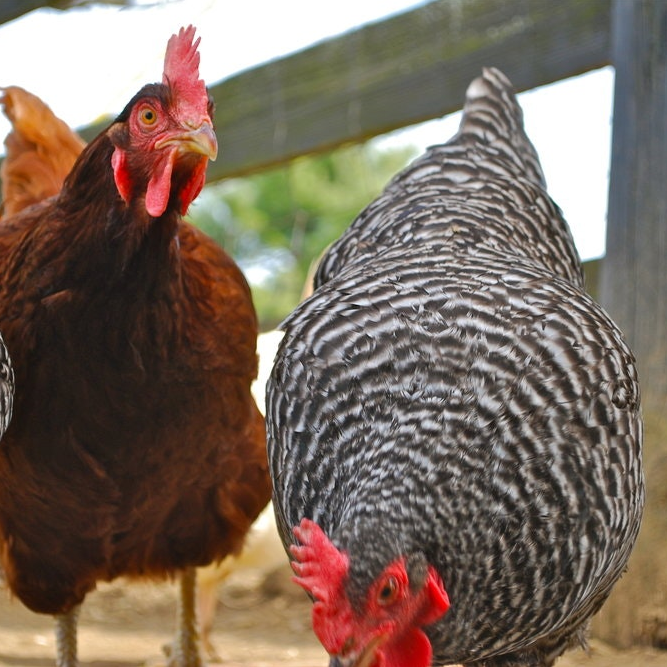
Just like our beef, our poultry is produced naturally. Our chickens allowed to range freely outdoors on "pasture" where they can eat whatever grass, seeds, insects and worms they choose. Not only does this result in more nutritious eggs and meat for consumers, but our chickens also benefit from these humane conditions and live healthier lives.
Our chickens are free of antibiotics and added growth hormones. Over half of the antibiotics fed to mass-produced farm animals are identical to the ones administered to humans. As has been well-publicized in the media, overuse of such antibiotics can lead to strains of bacteria resistant to the antibiotic, opening doors wider to the potential for human health problems and disease. Our broiler chickens are fed a specially prepared mix of locally raised non-GMO grains and natural supplements that promote good health.
What is Free-Range?
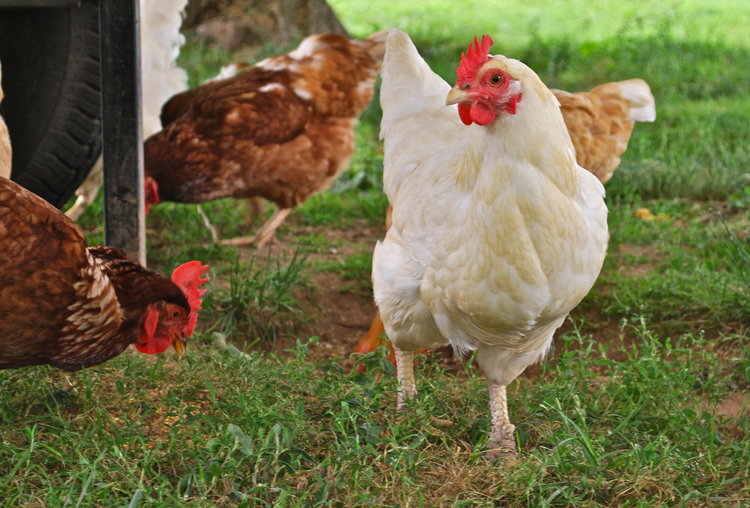
The USDA defines free-range as "allowed access to the outside". This inadequate definition leads producers to abuse this term and label their eggs or chickens as "free-range" when in fact all they do is allow their chickens to range in an outdoor area of bare dirt or concrete, with no pasture in sight.
At Rivercrest Farm we use a modified system that involves keeping our broiler chickens safe from predators by allowing them to graze t in hoop-shaped pens without bottoms) or inside electric fencing, and moving the pens and fencing frequently onto fresh pasture. Our layer flocks have unfettered access to the outdoors all day long and are secured only at night after they return to their roosts for protection against nocturnal predators.
Thus, pastured birds may be true free-range or penned, but either system is correctly referred to as "pastured." And either system is a far better choice than products that come from industrial factory farm conditions. Rivercrest Farm eggs and chicken are produced under true "pastured, free-range"conditions.
Pasture Eggs
A majority of the eggs sold in supermarkets are nutritionally inferior to eggs produced by hens allowed regular access to pasture. That's the conclusion reached following completion of the 2007 Mother Earth News egg testing project. Their testing found that, compared to the official U.S. Department of Agriculture (USDA) nutrient data for commercial eggs, eggs from hens raised on pasture may contain: 30% less cholesterol, 25% less saturated fat, 60% more Vitamin A, 2x more Omega-3 fatty acids, 3x more Vitamin E, 7X more beta carotene.
These amazing results come from 14 flocks around the country that range freely on pasture or are housed in moveable pens that are rotated frequently to maximize access to fresh pasture and protect the birds from predators. Six eggs from each of the 14 pastured flocks tested by an accredited laboratory in Portland, Ore. We think these dramatically differing nutrient levels are most likely the result of the different diets of birds that produce these two types of eggs. True free-range birds eat a chicken's natural diet - all kinds of seeds, green plants, insects and worms, usually along with grain or laying mash. Factory farm birds never even see the outdoors, let alone get to forage for their natural diet. Instead they are fed the cheapest possible mixture of corn, soy and/or cottonseed meals, with all kinds of additives.
After Mother Earth News published its first report about the high nutrient levels in pastured eggs, the Egg Nutrition Council questioned their "suggestion" that pastured eggs were better in their Aug. 8, 2005, newsletter:
"Barring special diets or breeds, egg nutrients are most likely similar for egg-laying hens, no matter how they are raised." There's that double-speak, again: "Barring special diets ..." Since when are diets not a part of how chickens are raised? Come on, people, we've cited six studies (see "Mounting Evidence", below) showing that pastured eggs are better. The best you can say is "most likely" this evidence is wrong? Cite some science to support your assertions! The U.S. Poultry and Egg Association offers the same misleading statement on its Web site:
"What are free-range eggs? Free-range eggs are from hens that live outdoors or have access to the outdoors. The nutrient content of eggs from free-range hens is the same as those from hens housed in production facilities with cages."
It's amazing what a group can do with a $20 million annual budget. That's what factory-farm egg producers pay to fund the AEB each year to convince the public to keep buying their eggs, which we now believe are substandard.
The Egg Board's misleading claims about free-range/pastured eggs pervade the Internet, even though the Board has been aware of the evidence about the nutrient differences at least since our 2005 report. We found virtually the same (unsubstantiated) claim denying any difference in nutrient content on Web sites of the American Council on Science and Health (an industry-funded nonprofit), the Iowa Egg Council, the Georgia Egg Commission, the Alberta (Canada) Egg Producers, Hormel Foods, CalMaine Foods and NuCal Foods ("the largest distributor of shell eggs in the Western United States").
But the most ridiculous online comments turned up at www.supermarketguru.com, a site maintained by a "food trends consultant." It says:
"FREE RANGE: Probably the most misunderstood of all claims, it's important to note that hens basically stay near their food, water and nests, and the idea of a happy-go-lucky bird scampering across a field is far from the natural way of life. The claim only means that the hens have access to the outdoors, not that they avail themselves of the opportunity. The hens produce fewer eggs so they are more expensive; higher product costs add to the price of the eggs. The nutrient content is the same as other eggs."
If you've ever been around chickens, you know that whoever wrote that hasn't. Chickens will spend almost their entire day ranging around a property scratching and searching for food. Even as tiny chicks, they are naturally curious and will begin eating grass and pecking curiously at any insects or even specks on the walls of their brooder box. "Scampering across a field," looking for food, is precisely their natural way of life.
Supermarket Guru did get one thing right, though. Free-range/pastured eggs are likely to be more expensive because production costs are higher. As usual, you get what you pay for. If you buy the cheapest supermarket eggs, you are not only missing out on the valuable nutrients eggs should and can contain, you are also supporting an industrial production system that treats animals cruelly and makes more sustainable, small-scale egg production difficult.

Mounting Evidence
-
In 1974, the British Journal of Nutrition found that pastured eggs had 50 percent more folic acid and 70 percent more vitamin B12 than eggs from factory farm hens.
-
In 1988, Artemis Simopoulos, co-author of The Omega Diet, found pastured eggs in Greece contained 13 times more omega-3 polyunsaturated fatty acids than U.S. commercial eggs.
-
A 1998 study in Animal Feed Science and Technology found that pastured eggs had higher omega-3s and vitamin E than eggs from caged hens.
-
A 1999 study by Barb Gorski at Pennsylvania State University found that eggs from pastured birds had 10 percent less fat, 34 percent less cholesterol, 40 percent more vitamin A, and four times the omega-3s compared to the standard USDA data. Her study also tested pastured chicken meat, and found it to have 21 percent less fat, 30 percent less saturated fat and 50 percent more vitamin A than the USDA standard.
-
In 2003, Heather Karsten at Pennsylvania State University compared eggs from two groups of Hy-Line variety hens, with one kept in standard crowded factory farm conditions and the other on mixed grass and legume pasture. The eggs had similar levels of fat and cholesterol, but the pastured eggs had three times more omega-3s, 220 percent more vitamin E and 62 percent more vitamin A than eggs from caged hens.
-
The 2005 study Mother Earth News conducted of four heritage-breed pastured flocks in Kansas found that pastured eggs had roughly half the cholesterol, 50 percent more vitamin E, and three times more beta carotene.
-
The 2007 results from 14 producers are shown here.